As a trusted skin cancer specialist in Brisbane, I see firsthand how seasonal shifts can affect my patients. The combination of low humidity, cold winds, and the use of indoor heating can strip your skin of its natural moisture, leading to dryness, irritation, and a compromised skin barrier . This is a critical time to adjust your skincare routine to protect your skin’s integrity and maintain its overall health.
Why Winter Dryness is a Concern in Queensland
Even though Queensland winters are mild, they can be surprisingly harsh on the skin. The drop in humidity draws moisture out from the skin’s surface, a process known as transepidermal water loss . When this happens, your skin can feel tight, flaky, and itchy. For those of us who spend time outdoors—whether for work or leisure—the combination of cool winds and the sun’s UV rays, which are still present, can further stress the skin’s protective barrier.
A Winter Skincare Strategy for Healthy Skin
Taking proactive steps during winter can make a significant difference. Here’s how you can protect and nourish your skin:
1. Rethink Your Cleanser
During winter, swap harsh, foaming cleansers for a gentle, hydrating cream cleanser that won’t strip away your skin’s natural oils. Look for products that are soap-free and formulated with moisturising ingredients .
2. Supercharge Your Moisturising Routine
This is the season for richer moisturisers. Applying a quality moisturiser after showering, while your skin is still slightly damp, helps lock in hydration. Don’t forget your hands, lips, and any areas prone to dryness .
3. Don’t Forget Your Sunscreen
This is non-negotiable. Queensland’s UV index can reach 3 or above all year round, meaning sun damage can occur even on cloudy winter days . Daily application of a broad-spectrum SPF30 or higher sunscreen is your best defence against skin cancer, which Australia has one of the highest rates of in the world .
4. Exfoliate Gently
Removing dead skin cells helps your moisturiser penetrate deeper and work more effectively. However, choose a gentle exfoliant to avoid irritating your winter-sensitive skin . A mild chemical exfoliant can be a better option than a harsh physical scrub .
5. Keep Up Your Regular Skin Checks
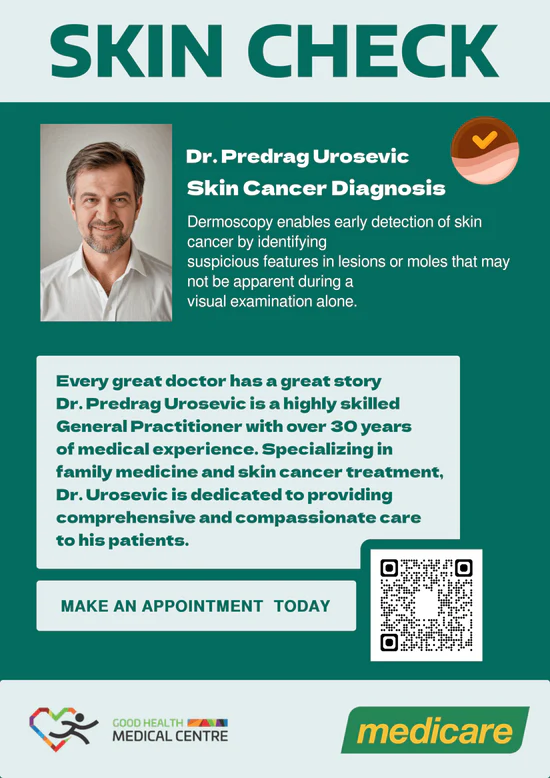
Winter is a perfect time to focus on proactive skin health. As Dr. P. Urosevic emphasizes, “Australia has one of the highest rates of skin cancer in the world” due to our high UV exposure and outdoor lifestyle. Regular skin checks are vital for early detection. Our clinic uses advanced techniques like dermoscopy and mole photo comparison to monitor your skin effectively and detect any changes promptly.

The Importance of Professional Skin Checks
A comprehensive skin examination is the cornerstone of skin health. In my practice, we use a dermatoscope, a non-invasive tool that provides a magnified view of skin lesions, allowing us to spot subtle features not visible to the naked eye. This improves the accuracy of our diagnosis and helps us guide decisions on whether a spot needs a biopsy or can be safely monitored .
For those who are particularly active—playing sports or working outdoors in Brisbane’s sun—a simple daily skincare routine, coupled with regular professional checks, is even more critical .
Your Skin Health is Our Priority
Don’t let the cooler weather lull you into a false sense of security. Your skin needs year-round care and vigilance. If you notice any new spots, changes in moles, or persistent skin issues, don’t wait.
Book your next skin check with us today. I see patients at our Carindale clinic on Saturdays and at our Garden City clinic on Mondays or Tuesdays. Walk-ins are also available .
Let us help you keep your skin healthy and protected, no matter the season.
Recommended Reading & Scientific References
Scientific References on Winter Skin Barrier Function
- Engebretsen, K. A., Johansen, J. D., Kezic, S., Linneberg, A., & Thyssen, J. P. (2016). The effect of environmental humidity and temperature on skin barrier function and dermatitis. Journal of the European Academy of Dermatology and Venereology, 30(2), 223-249.
- Denda, M. (2025). Effects of environmental humidity on skin health. SKINdeep.
- This review synthesizes evidence that a drastic decrease in environmental humidity induces barrier dysfunction and activates biochemical cascades of epidermal proliferation and inflammatory responses. Dry conditions stimulate the release of inflammatory cytokines from epidermal keratinocytes and affect whole-body pathology .
- Australian Journal of Pharmacy (2026). Weathering the season: a guide to winter skin. Australian Journal of Pharmacy, 107(1264), 55.
- Seasonal Effects on the Nasolabial Skin Condition.Skin Pharmacology and Physiology, 22(1).
- Research demonstrating that nasolabial transepidermal water loss (TEWL) is significantly higher during winter than in autumn, with skin becoming more reddish and scaly. Significant differences in triglycerides and cholesterol esters indicate a functionally inferior hydrolipidic layer during winter .
- Filaggrin degradation products may explain higher rate of dermatitis in the winter.British Journal of Dermatology.
Sun Protection & Skin Cancer Prevention Resources
- ARPANSA (Australian Radiation Protection and Nuclear Safety Agency).Do you still need to check the UV index in winter?
- Cancer Council Australia.Be SunSmart.
- Queensland Health – Sunshine Coast Health.You need to be sun safe this winter – here’s why.
- Generation SunSmart.Sun protection in winter.
- Ochre Health.Together let’s combat Australia’s ‘national cancer’.
- HCF Australia.What does skin cancer look cancer? Sun safety tips.
- SKEYNDOR Australia Education Team (2026).Why Is My Skin Worse in Winter? Causes & Fixes.
- Provital.Winter Skincare: Strengthen Your Skin Barrier Naturally.
Key Takeaways from the Literature
Dr Predrag Urosevic
FMAS, FRACGP
Skin Cancer Specialist
References compiled to support evidence-based skin health information.